From Paradox to Infrastructure: Sustrato.ai and the Encoding of Epistemic Humility
Version: 1.8 — Pre-Zenodo (validated data)
Author: Rodolfo Leiva (Human-in-the-loop 2.0)
ORCID: 0009-0003-4251-2733
Date: April 2026
Abstract
This paper documents the methodological contradiction between researching the autonomy of older adults and using generic language models that inherit clinical surveillance biases pre-existing in the academic corpus. To address this friction, we present sustrato.ai, an AI-assisted systematic review platform that encodes interpretive traceability through a structured three-iteration dialogue between a human researcher and AI, backed by an immutable append-only registry with SHA-256 cryptographic verification.
The platform was deployed in an empirical pilot that processed 257 scientific articles on artificial intelligence and older adults, identifying a primary subcorpus of 192 documents. Structured extraction reveals that 62.5% of these articles restrict their evaluation to clinical or technical performance metrics, while only 9 studies address leisure granting protagonist agency to the older adult. Simultaneously, the project demonstrates that the barrier to conducting this level of scrutiny is not budgetary: against a literature where 77.6% of funding is endogenous academic patronage, the total automated API processing cost was less than one US dollar.
The convergence of these empirical and architectural results allows the following interpretation: the infrastructure used to review the literature conditions what becomes visible within it. Sustrato.ai proposes a reproducible model for methodologically documenting the friction between human judgment and algorithmic classification.
Keywords: AI-assisted systematic review, append-only architecture, interpretive traceability, older adults, leisure, algorithmic bias, human-AI co-research, data sovereignty.
§1 — Introduction: The Foundational Paradox
This paper documents the genesis, architecture, and preliminary results of sustrato.ai, an AI-assisted systematic literature review platform. Its development (2023–2026) responds to a concrete methodological contradiction: what happens when the language models used to analyze human autonomy reproduce, through inheritance from the academic corpus that trained them, the very biases the research seeks to identify?
The platform emerged from the friction between a research question centered on the proactive leisure of older adults through AI, and the inability of available generic tools to process the literature without inheriting historical clinical biases. This document describes how that methodological need compelled the research team to transition from users of commercial AI to architects of their own infrastructure, and how that infrastructure, by embedding principles of traceability and integrity in its code, revealed patterns in the literature that conventional methods had not documented.
The work presents two interrelated contributions: (1) the empirical findings from a pilot of 257 articles on AI and older adults in the domain of leisure — where only 9 articles in the entire corpus address the older adult as protagonist of their free time through artificial intelligence — and (2) the description of sustrato.ai as a reproducible methodological contribution. Both require each other: without the pilot, the platform lacks evidence; without the platform, the findings would not have been possible with existing tools.
§2 — Context: From Hardware to Rights
The project's starting point was an epistemological decision. In late 2023, the intersection of technology and aging was dominated by the narrative of virtual reality (VR) as a solution to social isolation among the elderly. Against this paradigm, the research team chose to discard VR and focus on exploring how artificial intelligence could foster autonomy through leisure. This choice was anchored in Article 22 of the Inter-American Convention on Protecting the Human Rights of Older Persons (OAS, 2015), which establishes the right to recreation, physical activity, leisure, and sport, with the purpose of promoting self-realization, independence, autonomy, and inclusion in the community. The focus shifted from hardware to rights: from passive surveillance to proactive enjoyment of free time.
This choice is further grounded in a consolidated disciplinary tradition. Leisure gerontology — an academic field with a presence in specialized journals since 1981 (Activities, Adaptation & Aging) and theoretical development since the 1990s — has documented that leisure operates as a critical dimension of well-being in old age. Longitudinal research with older adults across multiple European countries shows that those who maintain active participation in leisure activities exhibit sustained improvements in quality of life, while sustained inactivity is associated with decline (Nimrod & Shira, 2016). The theoretical mechanism explaining this relationship involves the social support generated by shared activities and the self-determination dispositions — perceived freedom and intrinsic motivation — that leisure activates (Coleman & Iso-Ahola, 1993). However, the intersection of leisure, artificial intelligence, and older adults remains virtually unexplored: the literature review identified no study published before 2024 that simultaneously addressed these three
dimensions, and the first emerging works come from East Asia (Kim et al., 2024). This dual absence — temporal and geographic — reinforces the pilot’s relevance.
Subsequent context offered elements to evaluate the initial decision to discard VR. In 2025, the sector’s leading company reported operating losses exceeding $19 billion in its virtual reality division, accumulating a deficit of approximately $83.6 billion since 2020. The company announced a workforce reduction of 10–15% in that division and a redirection of resources toward artificial intelligence and lightweight devices (Meta Platforms, 2026). In parallel, during the World Economic Forum in Davos (January 2026), the convergence of AI, robotics, and aging occupied a visible place on the agenda, with the proposal of humanoid robots as a response to caregiver shortages.
However, the industry’s predominant approach continues to treat care as a logistical problem to be technologically delegated, without incorporating the older adult’s perspective as an agent of their own well-being. The difference between sustrato.ai’s approach and the industry’s lies in the starting point: while the industry identified a market, this project started from a rights framework.
§3 — Methodological Crisis: The Forensic Microscope
The first phase of the research required analyzing a corpus of approximately 8,000 scientific articles. The inability to process this volume manually within viable timeframes led the team to use commercial language models through their public interface. The experiment revealed a systematic pattern: the model tended to assimilate the promotional language of academic abstracts, confusing passive monitoring systems (such as fall sensors) with tools for “active interaction” or “independence.”
This behavior was not interpreted as a model defect but as an indicator that biases present in the academic corpus were inherited by the model processing it. The literature on aging and technology, having historically prioritized clinical metrics over user experience, produced abstracts where the vocabulary of surveillance mixed with that of autonomy. The model, trained on that corpus, reproduced the confusion. This pattern is consistent with what researchers in socio-gerontology have termed “interventionist logic”: the conception of aging as a set of problems to be technologically solved, to the detriment of exploring lived experience and the older person’s agency (Neven & Peine, 2017, 2021). The framework of “algorithmic ageism” (Chu et al., 2022) and the WHO’s warnings (2022) about encoding age-related biases in AI systems provide additional theoretical context for this phenomenon.
To mitigate this problem, a structured logical framework was developed: a guided reasoning protocol composed of highly specific instructions that required the model to justify its classifications step by step under strict predefined criteria. This protocol succeeded in reducing erroneous classifications by externalizing and formalizing critical scrutiny in machine-processable language. However, its manual application — copying instructions article by article — generated an unscalable logistical bottleneck. The guided reasoning protocol solved the conceptual problem (bias inheritance) but not the operational one (scale).
This dual friction — conceptual and operational — was the catalyst that drove the construction of sustrato.ai as a standalone platform. The research demanded not just an analysis tool but an infrastructure that simultaneously solved two problems:
guiding the model's reasoning and providing structured persistence for the generated data. Commercial AI interfaces do not offer relational storage of produced classifications; each chat session is ephemeral and lacks schema. Sustrato.ai was designed so that each classification is born within a master data structure (project, phase, dimension, batch, role) that grants it context, traceability, and permanence from the first moment.
§4 — Architecture of sustrato.ai: Design Principles Embedded in Code
4.1 — From User to Architect
The transition from user of generic tools to builder of proprietary infrastructure was not planned but demanded by the research. Rapid-development solutions (low-code) and standard databases were evaluated and discarded for acting as closed systems that prevented the granular control necessary for multidimensional analysis. The decision was to build with Next.js 14 and Supabase (PostgreSQL), assuming control over the complete architecture.
The choice of a remote classification API instead of locally executed language models responds to a practical constraint: the computing equipment available to most researchers cannot run language models fluidly. API usage is pragmatism, not architectural preference. The ideal would be a local-first configuration; reality imposes a hybrid model where the AI processes remotely but the resulting data resides and is queried locally.
4.2 — Collaborative Pre-classification: The Three-Iteration Dialogue
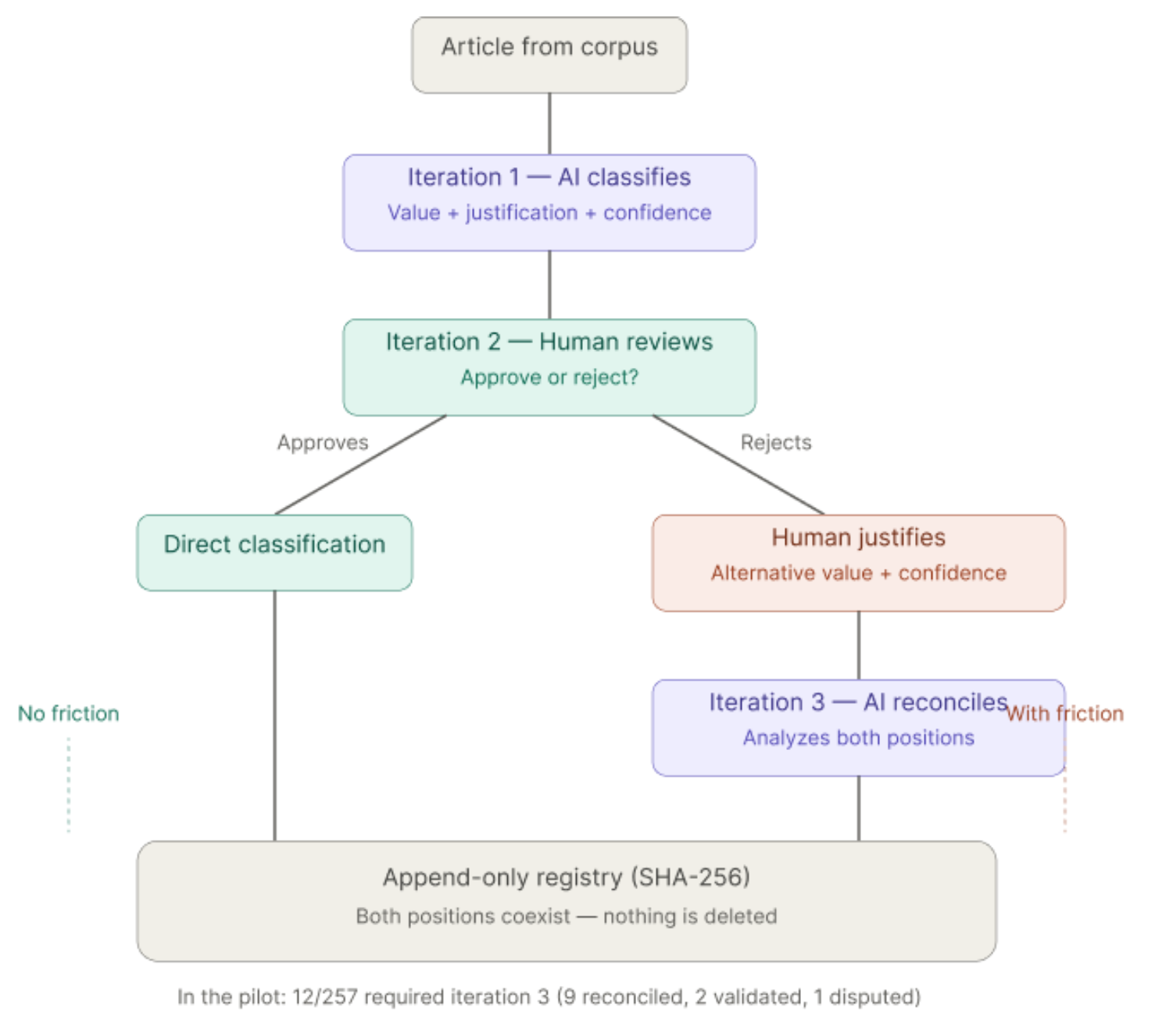
The pre-classification module implements a structured dialogue between the AI and the human researcher in a maximum of three iterations:
In the first iteration, the AI classifies the article according to configured dimensions, providing a value, a natural-language justification, and a confidence level. In the second, the researcher may approve or reject the classification; if rejecting, the system requires proposing an alternative value, justifying the disagreement in writing, and declaring their own confidence level. In the third iteration, the AI analyzes both positions and issues a reconciliation recorded as the official value.
This design prevents the researcher from adjusting data to preconceived hypotheses without the disagreement being documented. The machine does not hold “power” over the human; it closes the registry cycle, guaranteeing that both positions coexist in auditable form.
The three-iteration dialogue also serves a cognitive forcing function against passive approval. The literature on algorithmic output supervision documents that, when facing high volumes of information, the human operator tends to develop automatic acceptance behaviors toward system suggestions (Echterhoff et al., 2024). By
requiring the researcher to draft their own justification and declare their confidence level in case of rejection, the system blocks unreflective authorization cycles and forces scrutiny at the thresholds of interpretive divergence.
4.3 — Append-Only Architecture and Cryptographic Traceability
Each classification is stored in an append-only structure. Previous decisions are neither overwritten nor deleted. Each record carries a SHA-256 hash that verifies its integrity. Upon completing a batch, the researcher may finalize it, after which the system permanently locks its editing.
This architecture transforms friction points between the AI and the human into preserved qualitative data: they are not noise to be eliminated but signal to be documented.
4.4 — Phases, Dimensions, and the Serendipity Category
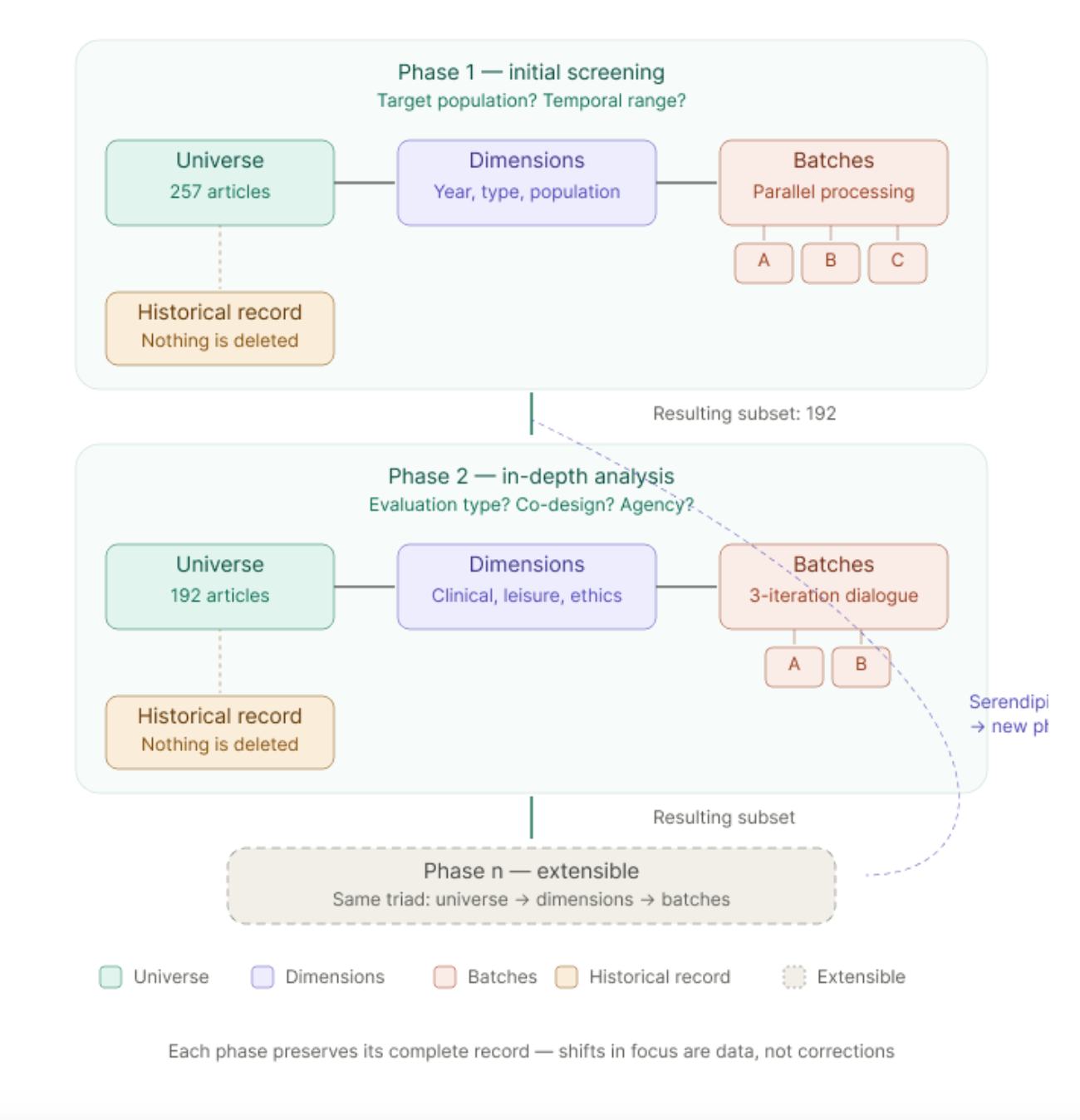
Pre-classification is organized in sequential phases that function as a logical funnel. Each phase defines a selectable universe of articles and a set of classification dimensions. Articles that pass one phase's filters feed the next phase's universe. Each phase remains as a historical record of the logic used at that moment; if a shift in focus occurs between phases, it is documented as methodological data, not as a silent correction.
Each dimension includes an open option called "Other (Serendipity)." When the AI encounters articles that do not fit predefined categories, it deposits them in this category with a description. In the pilot, serendipity captured between 1.0% and 15.6% of classifications depending on the dimension, revealing gaps in the original categories. This mechanism allows data to modify the theoretical framework, rather than forcing data to fit pre-existing categories.
Field note: During the pilot's initial calibration, it was observed that the serendipity peak in certain dimensions (15.6% in Operators) was not due to model errors but to a taxonomic bias of the research team itself: the predefined options were too deterministic and did not include intermediate categories such as "Mixed." The calibration process served not only to refine individual article classifications but to correct the dimensions themselves of the measurement instrument. This finding illustrates how sustrato.ai's architecture operates on two simultaneous levels: the data under analysis and the assumptions of the researcher analyzing them.
4.5 — Interface Oriented Toward Researcher Cognitive Ergonomics
The platform delegates complete visual configuration to the researcher: 9 color palettes with light/dark mode (18 variations), 6 selectable typographic pairs, and unique combination assignment per project. This decision responds to an operational principle: in prolonged classification sessions, the visual environment is a variable of cognitive ergonomics, not a constant of corporate identity. Each project receives a differentiated visual signature that functions as a contextual trigger, reducing fatigue errors when the researcher alternates between simultaneous corpora. The use of visual themes to signal work contexts is an established practice in software development environments; sustrato.ai adapts it to the academic research environment.
The containment of model responses to three strict vectors (classified value, bounded justification, and confidence level) constitutes an additional ergonomic protection measure. Recent literature on human-AI interaction documents the phenomenon of cognitive fatigue associated with continuous supervision of algorithmic outputs, showing measurable increases in decision fatigue and operator error rates when responses are verbose or redundant (Khan & Suhluli, 2025). Language models tend to exhibit Verbosity Compensation behavior, systematically inflating response length under uncertainty (Zhang et al., 2025). Controlled studies indicate that interfaces presenting information in structured, comparative formats significantly reduce cognitive load as measured by the NASA Task Load Index (Echterhoff et al., 2024).
Analysis queries are executed through interactive badges rather than query languages, and visualizations are exported in open formats (SVG, CSV).
4.6 — Calibration Prior to Batch Processing
Before initiating pre-classification of a complete batch, the system allows the researcher to test their definitions against individual articles from the corpus. The calibration tool displays the AI's proposed classification, its confidence level, and its justification. If the AI does not correctly interpret the instructions, the researcher adjusts the dimension's description or examples before processing hundreds of documents. This step transforms pre-classification into a calibrated process rather than an act of faith.
4.7 — Data Sovereignty and Research Economics
The AI intervenes through the API only once to classify each article. From that moment, data resides in local PostgreSQL. The researcher navigates, filters, cross-references dimensions, and generates certified exports at no additional cost and without dependence on external services.
The decision to use relational PostgreSQL — instead of vector databases or embedding models — is deliberate: it eliminates recurring per-query costs and specialized infrastructure dependencies. The total API cost for complete processing of the pilot (257 articles in two classification phases plus 64 articles in an ethical depth phase) was less than one dollar (estimated range: $0.03–$0.15 USD based on public API prices, April 2026; detailed calculation available as supplementary material). The platform operates at a monthly cost below $0.50 USD.
4.8 — Positioning in the State of the Art
The append-only architecture principle is an established pattern in domains such as genomic data management (where platforms like Overture implement it to guarantee primary data immutability; Ontario Institute for Cancer Research, 2025) and autonomous AI agent auditing (where proposals like Faramesh — Fatmi, 2026, arXiv:2601.17744 — apply immutable decision records). Sustrato.ai applies this same principle to a distinct domain: traceability of the interpretive process in AI-assisted literature reviews. It protects not only input data nor only algorithmic decisions, but the complete methodological conversation between researcher and artificial intelligence.
In the specific field of AI-assisted systematic reviews, established tools such as ASReview (open-source, based on active learning; van de Schoot et al., 2021), Rayyan (freemium, oriented toward collaborative screening; Ouzzani et al., 2016), and Covidence (Cochrane standard) offer article prioritization and filtering functionalities. However, these tools operate under a binary inclusion/exclusion paradigm and do not document the immutable traceability of the classification process nor formally record disagreements between algorithmic recommendations and researcher decisions. Sustrato.ai operates at a different level: multidimensional pre-classification with append-only registry of the complete interpretive dialogue, at an operating cost below the most economical market options. Annual licenses for standard qualitative analysis and systematic review screening tools range from $60 to $2,215 per individual researcher (range verified at public prices, April 2026), versus the less-than-one-dollar cost of the complete pilot in sustrato.ai.
Additionally, in the field of transparency in AI use for systematic reviews, the PRISMA-trAlce checklist (Holst et al., 2025) proposes an extension of the PRISMA 2020 standard requiring documentation of the model used, prompts employed, and
human supervision process. Sustrato.ai implements by design what PRISMA-trAIce establishes as a manual checklist.
§5 — Empirical Findings: The Leisure/AI Pilot in Older Adults
The data presented below were extracted through sustrato.ai's pre-classification module from a corpus of 257 scientific articles on AI and older adults, processed between 2024 and 2026. Of these, 192 had older adults as their primary target population. All percentages reported in this section were verified against the platform's certified exports (April 13, 2026).
5.1 — Predominance of Clinical Metrics Over User Experience
Of the 192 articles focused on older adults, 120 (62.5%) restrict their evaluation to clinical or technical performance metrics, without addressing the user's qualitative experience. 60 articles (31.3%) incorporate some qualitative or user experience dimension. 8 articles (4.2%) include mixed approaches. 4 articles (2.1%) were classified in the serendipity category. To date, no meta-analysis or systematic review has been identified that previously quantified this imbalance, although the finding is consistent with reviews documenting the prevalence of efficacy metrics over user experience in digital interventions for older adults (Takano et al., 2023; Huang & Oteng, 2023).
5.2 — Participation and Co-design
117 articles (60.9%) do not mention older adult participation in the design of the studied technology. 64 articles (33.3%) include them as test users (testing). 8 articles (4.2%) implement participatory co-design. 3 articles (1.6%) were classified as serendipity.
5.3 — Agency and Leisure
Of the 56 articles where the older adult operates as a technology user, 34 grant protagonist agency. Of these 34, 70.6% (24) are limited to interactions with access terminals (smartphones). When filtering for leisure as the primary research focus, the corpus is reduced to 9 articles. When expanding the universe to all 192 articles with older adults as focus, only 16 (8.3%) have leisure as a primary mention; 37 (19.3%) mention it as a secondary aspect; and 139 (72.4%) do not mention AI in relation to leisure.
5.4 — Funding and the Academic Circuit
149 articles (77.6%) are sponsored by academic institutions or research funds. 16 (8.3%) by health institutions. 8 (4.2%) by the State. 7 (3.6%) by technology companies. 5 (2.6%) by nursing homes. 7 (3.6%) were classified as serendipity.
5.5 — Ethical Dimension
147 articles (76.6%) do not address ethical or privacy aspects. Of the 43 (22.4%) that do, an ethical depth analysis of this subset reveals: 17 (39.5%) with integrated treatment, 13 (30.2%) contextual, 9 (20.9%) as a central research axis, and 4 (9.3%) with protocolar mention.
5.6 — Temporal Distribution
130 articles (67.7%) correspond to the 2020–2024 period. 51 articles (26.6%) to the 2025–2026 period. 11 articles (5.7%) were classified as serendipity due to temporal ambiguity or research-publication lag.
5.7 — Human-AI Friction Profile in the Pilot
Of the total 257 articles processed, 12 required the complete three-iteration cycle due to initial disagreement between the AI and the researcher. In 9 of these cases, the third iteration produced a reconciled classification. In 2 cases, the researcher reconsidered their initial position after the AI’s justification. In 1 case, the discrepancy persisted and the article was marked as disputed, with both classifications preserved in the append-only registry for future qualitative review.
The distribution of discrepancies by dimension reveals interpretive patterns: 4 cases in “Addresses perceptions/experiences,” 4 in “Deployment Topology,” 3 in “Operators,” and 1 in “Participatory Design.” In 4 of the 12 cases, the AI’s position prevailed in reconciliation; in 8, the researcher’s prevailed. This asymmetry does not indicate the superiority of either party: it reflects that the researcher, familiarized with the domain after months of development, contributed context that the model could not infer from the abstract — while the AI, on occasions, identified conceptual distinctions that the researcher had overlooked.
An illustrative case: an article about the IUPHAR Geriatric Committee was classified by the AI as “Academic Committee / International Organization.” The researcher proposed “Clinical Staff,” interpreting “geriatric” as synonymous with “practicing geriatricians.” The AI defended its position arguing that IUPHAR is an advocacy entity that issues guidelines, not clinical staff in practice. The reconciliation validated the AI’s position. This type of friction is not competition but calibration: the record documents a moment of mutual learning, not an error to be corrected.
The explicit friction rate (12 of 257, 4.7%) should not be interpreted as an indicator of algorithmic performance nor as automatic validation of the process. In this pilot, it reflects the confluence of an intensive prior calibration phase of the dimensions (where the 15.6% serendipity peak corrected the instrument before batch processing), a researcher familiarized with the domain and the tool after a prolonged period of methodological development (2024–2026), and the relatively stable nature of the categories analyzed in the final phases.
In broader adoption contexts, higher friction rates could indicate researcher team learning, corpus complexity, or dimensions requiring recalibration — not necessarily system failure. Sustrato.ai’s architecture documents all these scenarios equivalently: rapid agreement and prolonged disagreement carry the same cryptographic weight in the registry.
5.8 — Serendipity as a Finding: Emergent Taxonomy of Applications
Of the 3,405 classifications performed in the pilot (257 articles × 13 dimensions across 3 phases), 346 (10.2%) were categorized as serendipity (“Other”). This rate does not represent algorithmic failure but rather documented friction between predefined categories and the reality of the corpus.
The distribution by phase reveals an interpretable pattern: in the initial calibration phase, the rate was 3.9% (71 of 1,799 classifications); in the refinement phase, 17.8% (274 of 1,542); and in the ethical depth phase, 1.6% (1 of 64). The elevated
rate in the refinement phase corresponds to dimensions requiring architectural information (deployment topology, operational sovereignty) typically absent in scientific abstracts. This does not invalidate the dimensions; it documents a limitation of the source material.
Particularly revealing is the serendipity in the “Study Focus” dimension, where 22 articles (8.6% of 257) did not fit the anticipated leisure-clinical axis. Qualitative analysis of these cases reveals emergent categories: AI applications oriented toward emotional and psychological well-being (4 articles) — an axis that is neither clinical nor recreational but intermediate; research examining digital ageism, algorithmic harms, and AI biases (4 articles) — the field producing methodological self-critique; and specific non-categorizable applications (14 articles) including robotic companionship, motivational coaching, personalized reminiscence, perceived urban safety, and even attitudes toward digital immortality.
These 22 cases constitute empirical evidence that the literature on AI and older adults is diversifying beyond the “clinical surveillance vs. recreational entertainment” axis that dominated the field until 2020. The append-only architecture preserved these classifications as data, not as noise to be eliminated.
§6 — Discussion: Convergence of Findings and Architecture
The pilot's empirical findings and sustrato.ai's architecture do not operate in isolation; they constitute two elements of a single ecosystem that mutually validate each other.
Without the three-iteration design, the serendipity category, and the append-only architecture, the patterns documented in the previous section would have been difficult to detect with conventional tools. A language model operating without a guided reasoning protocol would have inherited the confusion between surveillance and autonomy present in academic abstracts, validating existing proportions rather than exposing them. The architecture functioned as an instrument that forced to the surface patterns that conventional review methods do not usually document: the proportion of studies that do not address user experience, the scarcity of leisure research with older adult agency, and the concentration of funding in endogenous academic circuits.
In turn, the empirical findings demonstrate the need for the architecture. If the academic literature on aging and technology presents the described patterns — clinical predominance, absence of co-design, ethical void — then the tools used to analyze that literature require mechanisms that prevent reproducing those same biases. The three-iteration dialogue, serendipity as a formal category, and registry immutability are design responses to documented empirical problems.
The convergence between both contributions allows the following interpretation: the way literature is reviewed conditions what is found within it. A tool that allows erasing disagreements, ignoring anomalies, and adjusting classifications post hoc produces different results than one that documents friction, preserves the unexpected, and certifies the process. Sustrato.ai is not a platform that “found” biases; it is a platform whose architecture makes visible what other tools allow to be overlooked.
An additional observation merits recording: the absence of disagreement between the AI and the researcher should not be interpreted as automatic validation of process quality. Progressive convergence between human and algorithmic criteria may reflect genuine instrument refinement, but it may also signal fatigue, habituation, or unreflective deference toward the model. Sustrato.ai's architecture documents both scenarios, but interpreting convergence requires methodological attention that exceeds the scope of this pilot.
The serendipity rate (10.2%) and the human-AI disagreement rate (4.7%, 12/257) function as complementary metrics of methodological friction. Both document the edges where predefined categories encounter empirical resistance. In a traditional systematic review model, these cases would be forcibly reclassified or excluded. Sustrato.ai preserves them as evidence of the interpretive process, allowing future research to identify patterns that the initial design did not anticipate.
§7 — Implications: Accessibility and Latency
The patterns documented in the pilot have a structural root. Historical surveys (Pew Research Center / AAAS, 2009, N=2,533) record that 87% of scientists identify lack of funding as a serious impediment to quality research, and that a similar proportion acknowledges that funding availability conditions the direction of what is investigated. The pilot's funding data (77.6% endogenous academic patronage, 4.2% state participation) are consistent with this pattern.
In this context, sustrato.ai's cost data acquires a dimension that exceeds the technical. If complete processing of a pilot at this scale costs less than one dollar in API fees, and the platform operates with low-cost local infrastructure, the barrier to conducting AI-assisted systematic reviews is not budgetary. It is one of design and access to adequate architectures.
The demand for traceability is not merely a methodological preference; it is an emerging institutional requirement. The European Commission has developed guidelines on the responsible use of generative AI in research, emphasizing traceability and audit records (European Research Area Forum, 2024). Publishers such as SAGE require authors to document the prompt used and the response generated when employing AI tools (SAGE Publications, 2024). ICMJE recommendations (January 2024) ask researchers to describe how AI was used in the research method. However, a recent systematic review of 246 studies employing language models in radiology documents that only 27.6% specify the model version used, while barely 41.1% include complete prompts (Šljivić et al., 2026), evidencing a gap between normative requirements and practice. Sustrato.ai resolves this gap by design: the registry of instructions, responses, model, and analytical process are not additional tasks but inherent consequences of using the platform. In the specific field of systematic reviews, the PRISMA-trAlce checklist (Holst et al., 2025) formalizes these traceability requirements; sustrato.ai implements them structurally.
This need for traceability is inscribed in a broader context of scientific integrity. Annual scientific retractions increased from approximately 1,000 in 2013 to more than 14,000 retraction notices in 2023, with more than 9,000 additional retractions in 2024 (Van Noorden, 2023; Retraction Watch Database, 2025). The integration of the Retraction Watch database into Crossref's public API (January 2025) now enables automatic verification of cited articles' status — an integrity infrastructure operating under the same traceability logic that sustrato.ai applies to the classification process (Crossref, 2025).
This accessibility has implications for contexts where economic resources are limited but unstructured data is abundant. The platform requires no permanent cloud subscriptions, no specialized infrastructure, no embedding API dependencies. It operates with open formats (CSV, SVG, Markdown) and standard technologies (Next.js, PostgreSQL).
Additionally, the single-processing-with-subsequent-emancipation model — where the AI intervenes once and data remains locally available — allows iterating over analyses at the speed research requires, without depending on the availability or cost of external services. This contrasts with the inherent latency of the traditional academic cycle, where the lag between research and publication may cause studies conducted with one technology version to be published when that version is already obsolete.
7.1 — The Interface as Infrastructure for Curiosity
The literature on cognitive fatigue in human-AI interaction (Khan & Suhluli, 2025; Echterhoff et al., 2024) explains what the platform seeks to avoid: researcher exhaustion. However, the pilot experience suggests an additional effect that exceeds error prevention.
Conventional literature review — sequential PDF reading, manual data extraction, spreadsheet annotation — constitutes a high cognitive load, low immediate feedback task. In sustrato.ai, the substitution of open dialogic interaction with structured justification boxes, access to the article’s full text through contextual tooltips, and visual coding through status badges appear to modulate the affective experience of the review process. The pilot’s researcher reports a qualitative change in the task experience: from the perception of effort over material of variable quality in a non-native language, to greater fluidity in interaction with the material.
This observation, anecdotal in the context of a pilot with a single operator, poses a relevant hypothesis for the design of future research infrastructures: economic and technical accessibility is a necessary but insufficient condition. The interface must sustain the researcher’s interest in the material, not just their capacity to process it. In an ecosystem where publication volume exceeds human reading capacity, tools that transform literature review from a tedious process into a guided exploration could alter the researcher’s relationship with their field’s state of the art.
The 22 serendipities in “Study Focus” suggest directions for future iterations: the leisure-clinical axis could expand to include “emotional well-being” (neither clinical nor recreational), “ethical meta-research” (the field examining itself), and “everyday agency” (non-medicalized companionship technologies). The corpus is signaling what the researcher did not ask.
§8 — Conclusion
The development of sustrato.ai (2023–2026) documents that the response to biases inherited by language models does not require rejecting the technology but designing infrastructures that encode the traceability of the interpretive process. The platform's value does not reside in its individual technical components — which use standard technologies and documented design patterns — but in their joint application to a specific problem: ensuring that collaboration between human researchers and artificial intelligence produces records that are auditable, reproducible, and resistant to posterior manipulation.
The platform's append-only architecture and cryptographic traceability are not limited to the domain of literature review. They constitute a reproducible prototype for future processes where documenting the friction between human criteria and algorithmic classifications is relevant: peer review, public policy analysis, data audits, or any process where method transparency is as important as the result. The capacity to process temporal deltas — incorporating new articles into the existing corpus and subjecting them to the same dimensions — will allow evaluating the evolution of documented patterns and the instrument's stability over time.
The empirical pilot on leisure, AI, and older adults demonstrates that the platform works and that the patterns it reveals — clinical predominance, absence of agency, ethical void, endogenous funding circuit — are documentable with accessible tools. The question remains open: how will scientific production change when research infrastructures incorporate, by design, the obligation to document every disagreement between human judgment and algorithmic classification.
§9 — Limitations
This project was developed as a collaborative initiative since 2023. For personal reasons beyond the scope of this document, since early 2026 it operates under the exclusive authorship and responsibility of the principal investigator. The methodological trajectory, corpus, architecture, and this text are direct continuations of the original work.
The pilot was executed in its final pre-classification phase (March 2026) by a single human researcher, previously trained in the specific domain and in using the platform over an extended period of methodological development (2024–2026). This intensive operator calibration simultaneously constitutes an internal strength (high consistency in classification criteria) and an external limitation (uncertainty about inter-coder variability if the platform were operated by teams without this level of prior immersion).
The analyzed corpus (n=257, subcorpus n=192) allows identifying patterns and proportions but does not reach the volume necessary for statistically robust generalizations to the complete field of AI and aging. Findings are presented as trend indicators, not population values.
The pilot's processing used DeepSeek API (model deepseek-chat, temperature 0.2) as the classification system. The model was selected for its economic accessibility and technological sovereignty relative to providers with restrictive quotas. The platform records the model at the system configuration level but does not inscribe it individually in each append-only record, which constitutes a pending improvement
for future temporal deltas. Reproduction of the analysis with a different model or a later version could produce variations in individual classifications, although the append-only architecture would preserve the traceability of both versions.
An anticipatable criticism is the absence of comparison between multiple language models. This decision is methodological, not budgetary. The pilot documents the interaction between a specific model, a specific researcher, and a specific corpus at a bounded temporal moment (2024–2026). Introducing multiple models would convert the study into an algorithmic performance benchmark — a different objective from the one proposed. Cross-model comparison is a matter for future research; this work prioritizes documentation of the interpretive process over classifier optimization.
The absence of formal inter-coder validation is the principal methodological limitation. Sustrato.ai's architecture is designed for collaborative teams with differentiated roles and disagreement records between multiple researchers, but this capacity was not exercised in the present pilot. Future studies with multiple coders and different experience levels are necessary to establish the platform's robustness in broader adoption contexts.
Finally, the observation about the interface as modulator of the researcher's affective experience (§7.1) is based on the report of a single operator and requires validation with broader samples and standardized cognitive load metrics.
References
- Chu, C. H., Niu, X., Storey, K., & Xie, B. (2022). Ageism and artificial intelligence: A scoping review. The Gerontologist, 62(3), e134–e145. https://doi.org/10.1093/geront/gnab154
- Coleman, D., & Iso-Ahola, S. E. (1993). Leisure and health: The role of social support and self-determination. Journal of Leisure Research, 25(2), 111–128. https://doi.org/10.1080/00222216.1993.11969913
- Crossref. (2025, January 29). Retraction Watch retractions now in the Crossref API [Blog post]. https://www.crossref.org/blog/retraction-watch-retractions-now-in-the-crossref-api/
- Echterhoff, J., Liu, Y., & Jiang, J. (2024). Avoiding decision fatigue with AI-assisted decision-making. Proceedings of IUI '24. ACM. https://doi.org/10.1145/3640543.3645205
- European Research Area Forum. (2024). Living guidelines on the responsible use of generative AI in research. European Commission.
- Fatmi, A. (2026). Faramesh: A protocol-agnostic execution control plane for autonomous agent systems. arXiv:2601.17744. https://arxiv.org/abs/2601.17744
- Holst, D., et al. (2025). Transparent reporting of AI in systematic literature reviews: Development of the PRISMA-trAlce checklist. JMIR AI, 4, e80247. https://doi.org/10.2196/80247
- Huang, K., & Oteng, B. (2023). Technology acceptance of older adults: A scoping review. Gerontechnology, 22(1), 1–15. https://doi.org/10.4017/gt.2023.22.1.001.00
- International Committee of Medical Journal Editors. (2024). Recommendations (Updated January 2024). Section V: Use of Artificial Intelligence. https://www.icmje.org/recommendations/browse/artificial-intelligence/
- Khan, M. F., & Suhluli, M. A. (2025). Generative AI and cognitive challenges in research. Technologies, 13(2), Article 45. https://doi.org/10.3390/technologies13020045
- Kim, H. J., et al. (2024). Leisure and happiness of the elderly: A machine learning approach. Sustainability, 16(7), 2730. https://doi.org/10.3390/su16072730
- Meta Platforms. (2026). Annual Report 2025 (Form 10-K). U.S. SEC. https://investor.fb.com/investor-resources/sec-filings
- Neven, A., & Peine, A. (2017). From triple win to triple sin. Societies, 7(3), Article 26. https://doi.org/10.3390/soc7030026
- Neven, A., & Peine, A. (2021). The co-constitution of ageing and technology. Ageing & Society, 41(12), 2845–2866. https://doi.org/10.1017/S0144686X20000483
- Nimrod, G., & Shrira, A. (2016). The paradox of leisure in later life. Journals of Gerontology: Series B, 71(1), 106–111. https://doi.org/10.1093/geronb/gbu143
- Ontario Institute for Cancer Research. (2025). Overture: An open-source genomics data platform. GigaScience, 14, g1af038. https://doi.org/10.1093/gigascience/g1af038
- Organización de los Estados Americanos. (2015). Convención Interamericana sobre la Protección de los Derechos Humanos de las Personas Mayores (Tratado A-70).
Organización Mundial de la Salud. (2022). Ageism in artificial intelligence for health: WHO policy brief.
Ouzzani, M., et al. (2016). Rayyan — a web and mobile app for systematic reviews. Systematic Reviews, 5, Article 210. https://doi.org/10.1186/s13643-016-0384-4
Pew Research Center / AAAS. (2009). Scientific achievements less prominent than a decade ago.
SAGE Publications. (2024). AI-generated content policy.
Šljivić, M., et al. (2026). Insufficient reporting quality in large language model studies in radiology. Insights into Imaging, 17, Article 58. https://doi.org/10.1186/s13244-026-02236-1
Takano, K., et al. (2023). A systematic review of user-based usability testing practices in self-care mHealth apps. Int. J. Medical Informatics, 178, 105158. https://doi.org/10.1016/j.ijmedinf.2023.105158
van de Schoot, R., et al. (2021). An open source machine learning framework for efficient and transparent systematic reviews. Nature Machine Intelligence, 3(2), 125–133. https://doi.org/10.1038/s42256-020-00287-7
Van Noorden, R. (2023). More than 10,000 research papers were retracted in 2023. Nature, 624, 479–481. https://doi.org/10.1038/d41586-023-03974-8
Zhang, Y., et al. (2025). Demystify verbosity compensation behavior of large language models. UncertainNLP Workshop, ACL 2025. https://aclanthology.org/2025.uncertainlp-main.14
Tone: We do not judge; we notarize. Data is presented; the reader concludes.
Figures: (1) Phase chain diagram (§4.4): fig1_cadena_fases_paper.svg — (2) Three-iteration dialogue (§4.2): fig2_dialogo_tres_iteraciones.svg
Validated exports (April 13, 2026): Phases 1, 2, and 4 with SHA-256 certified hashes.